
8 June 2026 (closed)
Jakarta Composite Index (5,746.65) +404.51 +7.57%
Bank Indonesia Goes for Unexpected Interest Rate Increase to Support Rupiah
Seeing the fragile rupiah, Bank Indonesia did not want to wait for its next scheduled monthly monetary policy meeting on 17-18 June 2026. Instead, the central bank of Indonesia raised its benchmark interest rate (BI Rate) by 25 basis points (bps) to 5.50 percent on Tuesday 9 June 2025.
This move comes less than three weeks after Bank Indonesia has already raised the BI Rate by 50 bps in mid-May 2026. It felt the need to act fast as the rupiah rate has been showing a weaker performance than Bank Indonesia had projected. Meanwhile, the central bank also raised the deposit facility rate and the lending facility rate by 25 bps, each, to 4.50 percent and 6.25 percent, respectively.
Bank Indonesia confirmed in a statement that this rate hike forms a further measure to strengthen the rupiah exchange rate amid the impact of heightened global turmoil triggered by the war in the Middle East, as well as a pre-emptive measure to maintain inflation within the government's target corridor of 1.5 - 3.5 percent year-on-year in both 2026 and 2027. Furthermore, the rate hike also aims to raise yields in an attempt to attract foreign portfolio investment inflows to Indonesia. One of the factors that is putting pressure on the rupiah is foreign portfolio investments from Indonesia.
Bank Indonesia's Benchmark Interest Rate (BI Rate):
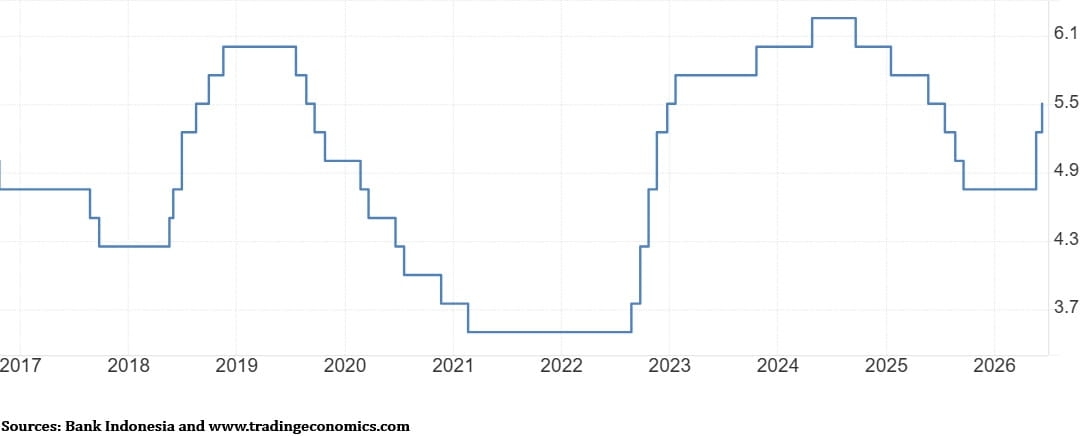
Just like the interest rate hike at the May 2026 monetary policy meeting, the move facilitated the instant strengthening of the rupiah on the day of announcement. On Tuesday (9 June 2026), the rupiah appreciated around 0.70 percent against the US dollar. However, across Asian markets it was a day of massive inflows that certainly contributed to rupiah strengthening too. Asian markets were supported by easing tensions in the Middle East that led to a declining global oil prices. The benchmark Jakarta Composite Index even soared by 7.57 percent, reportedly the steepest single-day increase in the post-Suharto era.
Bahas
Silakan login atau berlangganan untuk mengomentari kolom ini