
18 June 2026 (closed)
Jakarta Composite Index (6,172.34) -48.40 -0.78%
Indonesia Investments Released April 2026 Report - Plastic & Energy Challenge
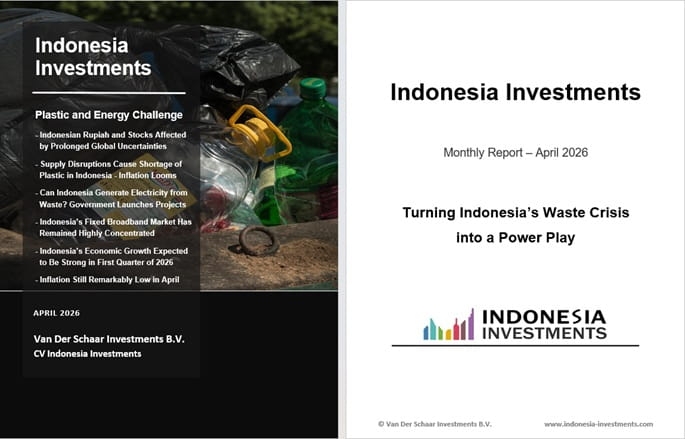
On Monday (04 May 2026), Indonesia Investments released the April 2026 edition of its monthly report. In this report we discuss key economic, political and social developments that occurred in Indonesia in April 2026.
Introduction
Little seems to have changed over the past month. The Iran War persists with no end in sight yet, implying that energy prices remain high due to supply chain disruptions related to the partial closure of the Strait of Hormuz. According to recently released reports from the International Monetary Fund and World Bank, the global economy is navigating a high-stakes environment characterized by slowing economic growth and renewed inflationary pressures.
Indonesia is certainly feeling the pressures that give rise to global financial turmoil. The Indonesian rupiah has been weakening significantly. So far in 2026, the rupiah depreciated nearly 4 percent from IDR 16,670 per US dollar at the year-start to IDR 17,300 per US dollar at the end of April 2026. Meanwhile, the benchmark stock index (Jakarta Composite Index) slid almost 20 percent in the first four months of 2026.
It is an age-old story: in times of global turmoil, the fragile emerging market assets are the first to be sold as investors seek the safe haven assets (and liquidity), causing significant capital outflows from Indonesia (which unfortunately ranks among those fragile emerging markets).
What is of particular concern to the investor community is that Indonesia, under the leadership of President Prabowo Subianto, shows a decline in fiscal discipline. There is a growing sense that this administration is not committed to keeping the budget deficit below the statutory 3 percent of GDP cap.
The controversial Free Nutritious Meal program remains the primary concern. With an estimated total cost of roughly IDR 400 trillion (approx. USD 23.1 billion) at full implementation, it represents a huge new permanent expenditure for the Prabowo administration, sparking skepticism regarding where the revenue will be sourced. If tax collection does not increase significantly, the government may need to increase the issuance of government bonds, which could drive up yields and raise borrowing costs. Moreover, while this program contributes to national economic growth, there are significant concerns regarding its transparency, efficiency, and potential fiscal leakage.
Secondly, despite the structurally high oil prices, the Prabowo administration is yet to adjust prices of subsidized fuels. This brings a massive burden for the state as the country is a net oil importer. While avoiding a fuel price hike does protect domestic purchasing power, it suggests that the government is not prioritizing fiscal health. Consequently, Indonesia recorded a state budget deficit of IDR 240.1 trillion (USD 14 billion) in Q1-2026, equivalent to 0.93 percent of GDP (significantly higher than the 0.41 percent ratio recorded in Q1-2025).
Beyond fiscal discipline, transparency also remains a key hurdle. In early 2026, MSCI suspended its assessment of certain Indonesian stocks following concerns over beneficial ownership transparency and high ownership concentration. In its formal update released in mid-April 2026, MSCI confirmed it will maintain its interim freeze on the Indonesian market until the May 2026 review, where it will evaluate whether the transparency reforms launched by the Financial Services Authority (OJK) and Indonesia Stock Exchange (IDX) are effective in practice.
Making matters worse, in February and March 2026 Moody’s Investors Service and Fitch Ratings had revised their outlooks from ‘stable’ to ‘negative’ amid "increasing policy uncertainty" and "weakening of governance and institutional strength." While Indonesia remains in the investment grade category, these negative outlooks act as a formal warning. If the government officially raises the deficit cap or if transparency concerns in the stock market are not resolved by mid-year, a rating downgrade could follow, which would significantly increase borrowing costs for both the government and Indonesian companies (and likely trigger massive capital outflows).
Meanwhile, Fitch Ratings also downgraded its credit outlook for four big Indonesian banks: Bank Mandiri, Bank Rakyat Indonesia (BRI), Bank Central Asia (BCA), and Bank Negara Indonesia (BNI). While their credit ratings remained at the BBB level, their outlooks were revised from ‘stable’ to ‘negative’ in March 2026. Fitch Ratings stated that the revision of Indonesia's debt outlook reflects rising policy uncertainty, with potential implications for medium-term fiscal direction and external buffers. Fitch added that the prolonged Iran conflict also poses downside risk if higher global energy prices weigh on borrowers' debt serviceability. Still, Fitch emphasized that the banking system of Indonesia remains healthy, with ample loan-loss reserves and robust capitalization, providing adequate buffers to absorb potential deterioration.
In summary, the key themes are (1) fiscal discipline and (2) transparency. These are the two issues that are making investors very cautious about investing in Indonesia. In combination with massive supply chain disruptions in the Strait of Hormuz, which might persist for a prolonged period of time as US President Donald Trump utilizes the blockade to hurt Iran (economically), this means Indonesia will continue to face significant pressure in the foreseeable future.
Sure, Indonesia is likely to continue seeing strong economic growth rates this year (particularly as shocks are absorbed by the government’s state budget). However, portfolio investors currently seem to prioritize fiscal discipline and transparency over growth. And therefore, we remain extremely cautious as the Indonesian rupiah, stocks and bonds are likely to remain under pressure, with the risk of capital flight outweighing the allure of the country’s fundamental growth story until a number of concrete policy guardrails are restored.
Finally, we must address inflation. In this month’s edition, we indeed zoom in on the inflationary pressures stemming from skyrocketing plastic prices, a crucial material that threatens to drive up costs across a wide range of consumer products.
Richard van der Schaar
Managing Director Indonesia Investments
Want to order the April 2026 report? The report (an electronic report, PDF, in English) can be ordered by contacting us through email and/or WhatsApp:
- info@indonesia-investments.com
- +62(0)882.9875.1125
Price of this report:
Rp 100,000 (or equivalent in other currencies)
Bahas
Silakan login atau berlangganan untuk mengomentari kolom ini