
12 June 2026 (closed)
Jakarta Composite Index (6,007.66) +121.62 +2.07%
Profiteering Over Policy: Rising Shadow of Corruption as Firms Cut Corners for MBG Contracts, A Case Study from Bantul
The Free Nutritious Meal program (in Indonesian: Makan Bergizi Gratis, abbreviated as MBG) is a true cornerstone of Indonesian President Prabowo Subianto’s domestic policy, representing one of the largest social welfare initiatives in the history of the country.
Launched in January 2025, the MBG program aims to address chronic malnutrition, reduce stunting rates, and improve the academic performance of the nation’s youth by providing daily free nutritious meals to approximately 82.9 million beneficiaries. This target group primarily includes the students from early childhood through high school, as well as pregnant and breastfeeding mothers.
The sheer scale of the MBG program is reflected in its massive fiscal requirements. In 2026, the program’s budget is projected to grow (possibly) up to IDR 335 trillion (approx. USD 20 billion), a significant increase from its initial 2025 allocation. These funds are managed by the newly established National Nutrition Agency (Badan Gizi Nasional) and are distributed in society through a network of service units known as SPPG (Satuan Pelayanan Pemenuhan Gizi). As of early 2026 the MBG program has reached over 60 million beneficiaries, operating over 24,000 kitchens.
Besides its direct social goals (improving health and education), the MBG program is also designed to function as an economic catalyst, with the government estimating it will create nearly one million jobs and revitalize the regional agricultural sector by requiring vast amounts of rice, meat, milk and vegetables to be sourced from local farmers and cooperatives.
Risks and Regulatory Challenges
However, the rapid rollout has not been without controversy. Implementation has faced logistical hurdles, including concerns over food and hygiene safety (following reported incidents of food poisoning) as well as debate regarding the cutting of the national education budget to fund these meals. In the state budget (or APBN) annex, which takes the form of a Presidential Regulation, it is also clearly stated that out of the IDR 769 trillion (or approx. USD $46 billion) that is set aside in the APBN for the education budget, roughly IDR 223.5 trillion (approx. USD $13 billion) is allocated for the MBG program.
This is an interesting matter as the Indonesian Constitution requires 20 percent of the state budget to go to education. However, by reclassifying feeding as education, the government technically meets this 20 percent rule but there is concern whether there is enough money left to spend on necessary infrastructure and teacher salaries in the education system.
The challenges created a high-stakes environment where strict regulatory oversight is essential to prevent any potential ‘vultures’ (referring to bad actors and corrupt entities) from draining the massive public funds intended for the nation's children.
The main regulatory challenge lies in the selection of vendors for the MBG kitchens (the SPPG units) around the country. The risk is that shell companies, or politically connected entities, may attempt to bypass the background checks and evaluations to secure multi-billion-rupiah contracts. The consequence when ‘vultures’ prioritize profit margins over nutritional standards, is that the quality of meals (and therefore the health of the 82 million beneficiaries) is compromised.
[...]
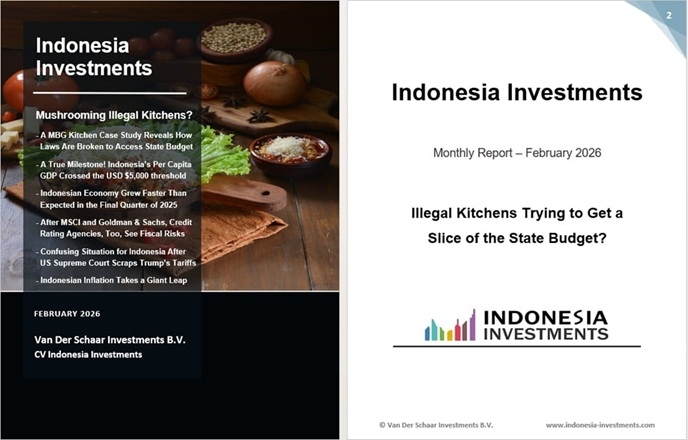
Want to read the full article? It is available in our February 2026 report (an electronic report, PDF, in English) that can be ordered by contacting us through email and/or WhatsApp:
- info@indonesia-investments.com
- +62(0)882.9875.1125
Price of this report:
Rp 100,000 (or equivalent in other currencies)
Bahas
Silakan login atau berlangganan untuk mengomentari kolom ini