
4 June 2026 (closed)
Jakarta Composite Index (5,839.79) -101.28 -1.70%
Overview of the Palm Oil Sector in Indonesia – Challenges and Opportunities in 2026
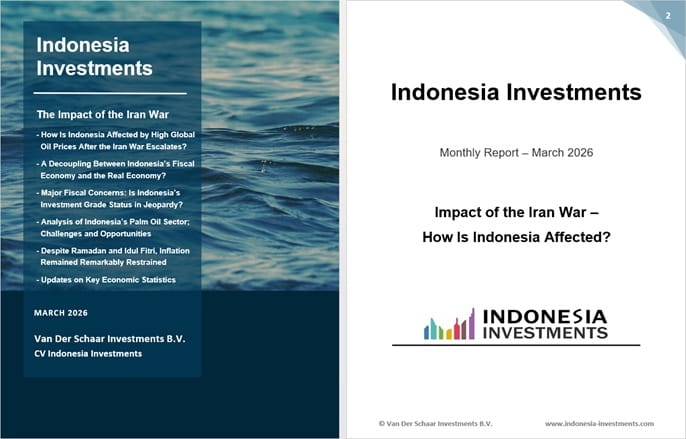
This report discusses Indonesia's palm oil sector. First, we give an overview of the role palm oil plays on the global stage, before zooming in on Indonesia. We discuss oil palm plantations across Indonesia, crude palm oil (CPO) productivity, CPO and palm kernel oil production, sustainability and environmental concerns, domestic consumption of palm oil (specifically the biodiesel program), and exports.
Indonesia is the world’s biggest producer and exporter of palm oil. This means that the palm oil sector is an important asset to the country. It provides employment and earnings to millions of Indonesians, injects lucrative foreign exchange earnings into Indonesia (that support the trade balance, current account balance and rupiah rate), and Indonesia is using its crude palm oil (CPO) to make biodiesel (thereby reducing the nation’s dependence on expensive imports of fuel and crude oil) as well as other value-added products (such as oleochemicals and specialized refined products).
In fact, in times of economic crises, palm oil actually functions as a shock absorber for Indonesia. For example, rising revenues from palm oil exports played a crucial role in kickstarting the recoveries from the Asian Financial Crisis in 1997-1998 and the COVID-19 crisis in 2020-2021. Crucial is that palm oil is priced in US dollars, and so heavy rupiah weakness creates a massive advantage for the palm oil industry. It makes palm oil one of the few sectors capable of generating immediate liquidity and foreign exchange reserves when the rest of the (Indonesian) economy is paralyzed (coal mining is another crucial industry in this context).
Overall, the palm oil sector is estimated to contribute between 3.5 and 3.8 percent to Indonesian gross domestic product (GDP), with total earnings from the palm oil sector being around USD $64 billion (upstream-downstream). Some analysts argue that the value of the palm oil sector can, in fact, be doubled in the next couple of years provided productivity improves (via oil palm replanting or rejuvenation programs), logistics costs ease, and the legal/regulatory environment improves (incl. enhancing the sustainability of Indonesian palm oil to safeguard continued global demand for Indonesian palm oil as there exists competition from Malaysia).
At the same time, however, there are a number of challenges that are being faced by Indonesia. Several overseas markets have become stricter in terms of allowing palm oil to enter their territories (amid concern over deforestation after the decades-long, aggressive expansion of palm oil cultivation). Moreover, production of CPO seems to have hit a ceiling as we see stagnant production in recent years (which is related to millions of hectares oil palm estates being over-aged, hence producing fewer fruit), while geopolitical turmoil in recent years has significantly raised prices of fertilizers.
Furthermore, Indonesia’s biodiesel program is actually jeopardizing the amount of CPO supplies that are available for exports or for cooking oil on the domestic market. If the B50 program will come into effect, then perhaps only 10-15 percent of national palm oil production becomes available for export purposes. This emphasizes the need for raising productivity on the existing oil palm plantations in order to increase national production.
The Popularity of Palm Oil
Palm oil is the most widely consumed vegetable oil on the planet as it can be found in roughly 50 percent of all packaged products in supermarkets, ranging from food items (including baked goods, snacks, frozen foods, and spreads), and personal care or household products (including soaps and detergents, cosmetics, and hair care) to industrial use (such as biofuel, lubricants, and animal feed). The dominance of palm oil is driven by its unique combination of the following three factors:
- Efficiency;
- Versatile chemistry; and
- Low-cost nature of oil palm farming.
In terms of efficiency, oil palms produce significantly more oil per hectare than any other oilseed crop (such as rapeseed, sunflower, and soybean). Requiring much less land to produce the same amount of oil, palm oil is significantly cheaper to produce and it can be argued that – technically – it therefore limits deforestation (but we will see below that there exists plenty of concern over the impact of oil palm farming in Indonesia on the environment).
Regarding its versatile chemistry, palm oil has a great advantage over other oilseed crops namely that it is naturally creamy and solid at room temperature (therefore it does not need to be chemically hardened), making it a great replacement for trans fats (for usage in margarines, spreads, and frostings). Moreover, palm oil is stable at high temperatures, making it ideal for industrial frying and snack/food production. It also does not interfere with the flavour of food, allowing it to be used in everything from chocolate to bread. And because it is resistant to oxidation, palm oil has a long shelf life.
In terms of its low-cost nature, it is crucial that palm oil production is concentrated in Indonesia and Malaysia (together accounting for about 83 percent of worldwide supply), and thus this industry has built massive, highly integrated supply chains. This allows global manufacturers to source vast quantities (reliably) and at a lower price point than almost any other fat source. Moreover, palm oil isn’t a seasonal crop, and therefore there is a constant supply (although weather anomalies can disrupt harvests). On average, the oil palm produces fruit bunches every two weeks (for up to 30 years, hence few replanting is needed).
What also supports the low-cost nature of palm oil in Indonesia is that the country has low labour costs.
Palm Oil Production Around the World
As mentioned above, Indonesia and Malaysia dominate global palm oil production, with Indonesia having the upper hand in the rivalry. Indonesia accounts for about 58 percent of global palm oil supplies, followed by Malaysia with a 25 percent share.
[...]
Want to read the full story? Order the March 2026 report! This report (an electronic report, PDF, in English) can be ordered by contacting us through email and/or WhatsApp:
- info@indonesia-investments.com
- +62(0)882.9875.1125
Price of this report:
Rp 150,000 (or equivalent in other currencies)
Bahas
Silakan login atau berlangganan untuk mengomentari kolom ini