
17 May 2026 (closed)
Jakarta Composite Index (6,723.40) -135.32 -1.98%
Digital Customer Onboarding Is Moving Beyond the Sign-Up Page
Digital customer onboarding no longer begins when someone creates an account. It begins when a person first notices a brand, reads the first offer page, sees a community update, or tries to understand what kind of experience is being presented. The sign-up page still matters, but it is now one point in a wider communication path. For digital businesses, that shift changes the job of onboarding. It has to introduce the first action, explain terms, and keep the customer oriented across channels.
The Welcome Page as the First Clear Signal
A strong onboarding path gives the customer a clear first layer before asking for deeper involvement. In online entertainment, that first layer often comes through a welcome page that explains the entry offer, available payment routes, timing, eligible games, and the terms attached to the experience. In today’s world, viewers will often look for the best casino welcome bonus page available before making a decision. Of course, best can be subjective, but a clear and easy to understand description of what is being offered is a very important quality for many people.
If you look at the above example, you’ll quickly see that there are two distinct first-deposit routes available to new customers: a card option with a 200% match up to $1,500 and 75 free spins, and a crypto option with a 300% match up to $2,000 and 150 free spins. It also names the games linked to the free spins, states the minimum deposit, and places the terms below the main offer explanation. Being clear and precise about the options available to someone joining the site is a great way to begin the onboarding process.
That same approach should continue after the initial welcome page. Creating a sense of community around your platform is often the next step in effective onboarding. Cafe Casino’s Instagram post inviting users to join their Discord shows how this can be done. By offering things such as news about updates, events, and giveaway announcements, it provides a clear incentive for users to join, which helps the community to grow. The post does not replace the details on the welcome page. It extends the journey by showing how a brand can keep the experience lively.
View this post on Instagram
Why Onboarding Has Become a Communication System
In the past, the older onboarding model was linear. A user landed on a page, registered, received a welcome message, and learned more about the product after logging in. That still happens, but it is no longer the whole story. While researching a potentially interesting site, users may move from search engines to social media, then to a landing page, and from there switch to a community space. Alternatively, they may go through the same locations but in a different order. Your onboarding process needs to account for multiple entry routes.
That makes onboarding less like a single tutorial and more like a sequence of clear signals. Each signal should answer one question in the customer’s mind. What is this platform? What is the first action? Where are the details? How does the brand communicate once I am interested?
| Onboarding | What it should clarify | Why it matters |
| First offer page | Opening experience and key conditions | Gives the customer a structured start |
| Social update | News, events, or reminders | Keeps communication light |
| Community space | Conversation and shared updates | Gives users a place to return |
| Help or terms area | Detailed explanations | Supports confidence |
Digital onboarding is strongest when each layer has a distinct purpose. A welcome page should not behave like a community feed, and a social post should not carry the full weight of detailed terms.
The Beginner-Friendly Value of Plain Sequencing
Good onboarding is not about adding more touchpoints. It is about arranging them in an order that feels natural. This is especially important for lifestyle and entertainment platforms, where many users are not experts and do not want technical language before they understand the basic experience.
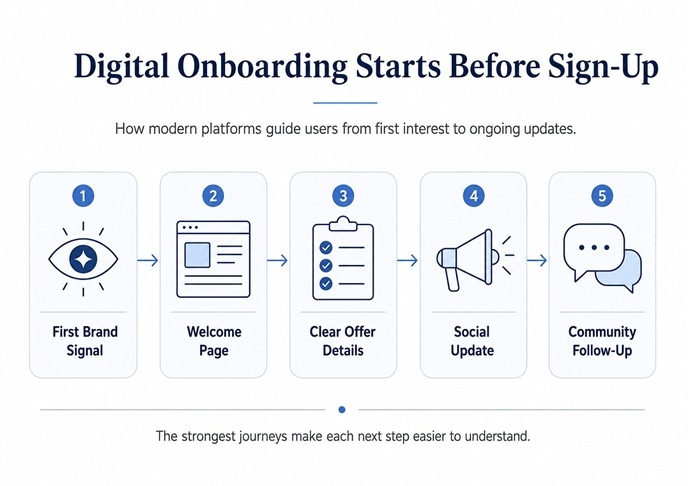
Plain sequencing respects that. The first page introduces the main offer. The next message gives people a reason to stay informed. The community channel adds continuity. The detailed terms remain available for people who want to read them before acting. None of these pieces have to be complicated, but each one should make the next step easier to understand.
What Businesses Should Prioritize
The larger business lesson is that onboarding now begins before the account exists. A person can form an impression from a headline, a social post, a welcome page, a short announcement, or a community invitation. Each contact point becomes part of the customer’s early understanding.
That is why digital customer onboarding deserves more attention as a business communication topic. Platforms need to consider how they should explain themselves before a user commits time, attention, or personal details. They need to guide people through the process using a few well-placed signals, then let the experience continue naturally over time. Research on online brand communities also supports this view by showing that customer interaction can help shape inspiration and connection when the environment is supportive and well-structured.