
12 June 2026 (closed)
Jakarta Composite Index (6,007.66) +121.62 +2.07%
Bank Indonesia Raises Benchmark Rate to 5.75% in Continuous Move to Stabilize Rupiah
The central bank of Indonesia (Bank Indonesia) is aggressively raising its benchmark interest rate (BI Rate) to support the rupiah rate, while it might also be expecting a significant acceleration in Indonesian inflation after the cabinet raised the price of Pertamax fuel by 32 percent on 10 June 2026.
Bank Indonesia is showing an aggressive attitude as the latest rate hike is the third one within the timespan of a month. On 20 May 2026, the central bank raised the rate by 50 basis points (bps) from 4.75 percent to 5.25 percent after the rupiah hit a record low position against the US dollar. This marked the first rate hike of the year to combat global macroeconomic volatility and Middle East geopolitical tensions.
Just a few weeks later, on 9 June 2026, Bank Indonesia imposed a 25 bps rate hike from 5.25 percent to 5.50 percent during a surprise, off-schedule weekly meeting following intense pressure on the rupiah. And now, after its scheduled monthly monetary policy meeting (17-18 June 2026) it used another 25 bps increase to reach 5.75 percent.
Bank Indonesia's Benchmark Interest Rate (%):
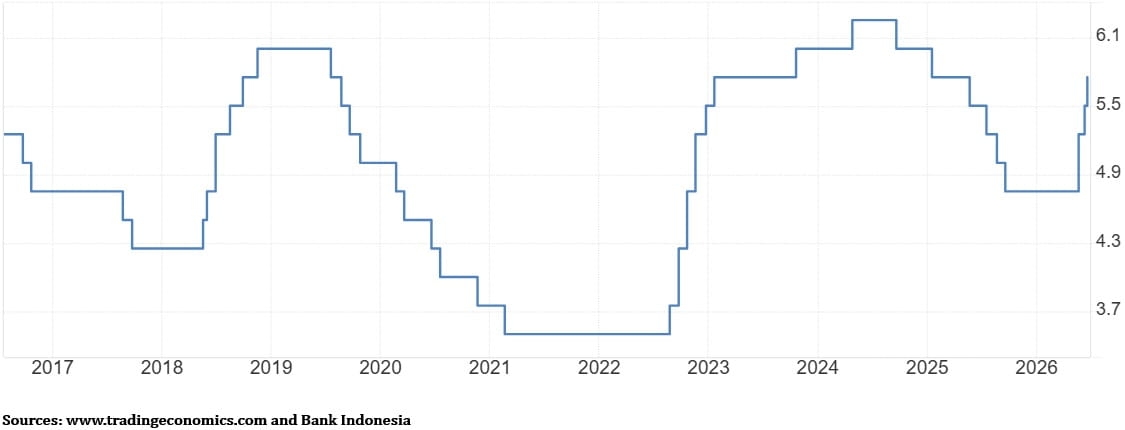
The deposit facility and lending facility rates were also increased by 25 bps to 4.75 percent and 6.50 percent, respectively. In a statement, Bank Indonesia announced that the decision for monetary tightening was done in an effort to further strengthen and stabilize the rupiah exchange rate against intense global uncertainty, and as a pre-emptive measure to ensure inflation remains within the government's target corridor of 1.5 - 3.5 percent year-on-year (y/y) for both 2026 and 2027.
To ensure this interest rate hike is effective, Bank Indonesia is also implementing several complementary measures, most notably:
(1) increasing foreign exchange interventions across spot, Domestic Non-Deliverable Forward (DNDF), and offshore NDF markets;
(2) keeping Bank Indonesia Rupiah Securities (SRBI) yields aligned with the new BI-Rate across 6, 9, and 12-month tenors to maintain foreign portfolio inflows;
(3) continuing a 10 percent hedging swap premium discount for foreign investors, and
(4) lowering the cash forex purchase threshold without an underlying asset to USD $10,000 per month as well as lowering the documentation requirement threshold for outgoing fund transfers from USD $50,000 to USD $25,000 to tighten capital monitoring (effective per 1 July 2026).
The rupiah, indeed, responded positively to the news, appreciating 0.17 percent against the US dollar after being in the red for most of the day. Indonesia's benchmark stock index (Jakarta Composite Index) on the other hand contracted by 0.78 percent. Typically, stocks are negatively affected by a rate hike as it increases borrowing costs, hence making it more expensive for companies to opt for business expansion programs.
Bahas
Silakan login atau berlangganan untuk mengomentari kolom ini