
12 June 2026 (closed)
Jakarta Composite Index (6,007.66) +121.62 +2.07%
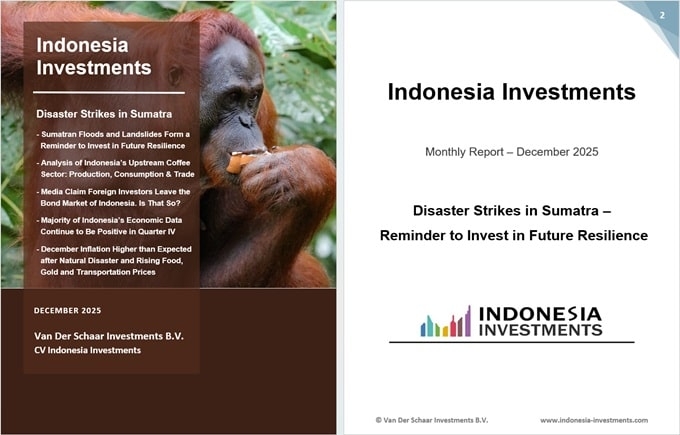
Sumatra Grappling with the Aftermath of One of Indonesia's Deadliest Natural Disasters in Years
Nature, the environment, and weather can be seen as Indonesia’s greatest allies. For instance, breathtaking natural scenery and the year-round tropical climate manage to attract millions of foreign tourists, annually.
Similarly, while volcanic eruptions are often viewed as purely destructive, they actually play a key role in creating fertile landscapes; volcanic ash and lava decompose to release essential plant nutrients like potassium, phosphorus, magnesium and calcium, while producing porous soil that retains moisture effectively, thereby boosting the nation's agricultural productivity.
However, these same natural phenomena can also transform into formidable foes, a reality Indonesia knows all too well. Situated along the Pacific Ring of Fire, a region characterized by intense tectonic activity, Indonesians live with the perennial risk of volcanic eruptions, earthquakes, and tsunamis. Furthermore, its tropical climate dictates an annual monsoon season (typically peaking in December–January) that brings the heavy, prolonged rainfall responsible for widespread seasonal flooding. The danger is often compounded when seismic activity triggers landslides that block river systems. When met with heavy rains, these natural dams can burst, thereby significantly intensifying the risk of catastrophic flooding.
Meanwhile, systemic issues in land and waste management add a significant layer of complexity to these natural threats. Deforestation and soil erosion reduce the land's natural absorption capacity, while the prevalence of littering and improper waste disposal can clog vital waterways. These human activities can quickly overwhelm river systems, significantly intensifying the scale and impact of seasonal flooding.
While aforementioned risks are significant in their own right, the situation escalates to a far more dangerous level when an extremely rare tropical cyclone enters the region. This is precisely the scenario that unfolded in late 2025, as Cyclone Senyar made its devastating transit through the region.
How Did Cyclonic Storm Senyar Develop?
A tropical cyclone, which typically forms over large bodies of relatively warm water as they derive their energy through the evaporation of water from the ocean surface, is a rapidly rotating storm with a low-pressure area, a closed low-level atmospheric circulation, strong winds, and a spiral arrangement of thunderstorms that produce heavy rain and squalls.
Depending on its location, this same phenomenon is identified by different names. It is known as a ‘hurricane’ in the Atlantic and Northeast Pacific, a ‘typhoon’ in the Northwest Pacific, and a ‘cyclone’ in the South Pacific and Indian Ocean.
[...]
Want to read the full article? Yes? Then order our December 2025 report! This report (an electronic report, PDF, in English) can be ordered by contacting us through email and/or WhatsApp:
- info@indonesia-investments.com
- +62(0)882.9875.1125
Price of this report:
Rp 150,000 (or equivalent in other currencies)
Take a glance inside the report here!
Bahas
Silakan login atau berlangganan untuk mengomentari kolom ini