12 June 2026 (closed)
Jakarta Composite Index (6,007.66) +121.62 +2.07%
Christianity in Indonesia
Although Christianity is the second-largest religion in Indonesia, it only forms a minority in the country. Around 10-11 percent of the Indonesian population is currently counted as Christian, a percentage which, in absolute terms, constitutes around 30 million people.
Interestingly, Indonesians customarily separate Catholicism from Christianity in daily life and on official documents. For most locals, the term Kristen (Christian) specifically refers to Protestantism, whereas Katolik (Catholicism) is treated as a distinct category. In line with Western tradition, we will apply the term Christianity as an umbrella term for both Protestantism and Catholicism, as the core theological essence of both branches is the same: the belief in Jesus Christ.
Table 1 - Breakdown of the Indonesian Population by Religion (2024):
| Religion | Percentage share (of total population) |
Absolute Number of People |
| Islam | 86.9% | 245,618,298 |
| Protestantism | 7.4% | 20,832,207 |
| Catholicism | 3.2% | 9,067,908 |
| Hinduism | 1.7% | 4,736,045 |
| Buddhism | 0.7% | 2,126,177 |
| Confucianism | 0.03% | 78,610 |
| Other Beliefs | 0.01% | 14,939 |
Source: www.satudata.kemenag.go.id/dataset/detail/jumlah-penduduk-menurut-agama
In Indonesia, Protestants outnumber Catholics. This stands in contrast to the global picture, where the Christian faith is dominated by Catholicism (roughly 50 percent), followed by Protestantism (37 percent), and Orthodoxy (12 percent). The colonial period played a decisive role in shaping this local inversion: the Dutch, who brought Protestantism, maintained a much longer and more widespread presence across the archipelago than the Portuguese, who introduced Catholicism. While the Dutch dominated overall, they deliberately left certain regions to Catholic missionaries later on (such as southern Papua and parts of East Nusa Tenggara), which is why those specific islands remain Catholic strongholds today despite the overall Protestant majority.
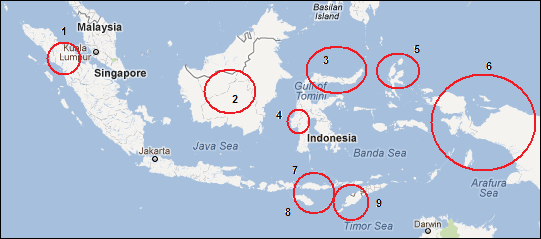
Table 1 reveals that the majority of Indonesian Christians are Protestant. Out of the roughly 30 million total Christians in the country, approximately 21 million adhere to Protestantism, while the remaining 9 million are Catholic. These Christian communities are distributed unevenly throughout the Archipelago. However, as can be seen on the map below, many of the areas with the highest relative concentration of Christians are located in the less populous, eastern parts of Indonesia (such as Papua and East Nusa Tenggara) as well as distinct pockets in the west, like North Sumatra.
Regions or provinces with substantial Christian communities are found in:
1. North Sumatra
2. Kalimantan
3. North Sulawesi
4. West Sulawesi
5. Moluccas
6. Papua
7. Flores
8. Sumba
9. West Timor
Arrival of Christianity in the Indonesian Archipelago
The first known source suggesting a Christian presence in the archipelago can be found in the encyclopedic work of Abu Salih Al-Armini, an Egyptian Christian who lived in the twelfth century. According to his writings, a number of Nestorian churches existed in West Sumatra around that time, located close to a region famed for its camphor production. However, later scholars have argued that Al-Armini may have confused this location with Mansura, a town in present-day India also noted in historical Arab texts for trade.
After the Portuguese conquered Malacca (in present-day Malaysia) in 1511, they sailed further eastward to locate the spice heartland of the Moluccas, then ruled by the Sultanate of Ternate. Here, the Portuguese established a small settlement. At first, relations between the Catholic Portuguese and the Muslim population of Ternate were harmonious, as both sides recognized the commercial advantages of mutual trade cooperation. From 1534 onward, Portuguese priests began actively converting locals to Catholicism; by the end of the sixteenth century, approximately 20 percent of the inhabitants of the Southern Moluccas were classified as Catholic. Two other locations in eastern Indonesia where the Portuguese established small Catholic settlements were Larantuka (on the island of Flores) and Dili (on the island of Timor). However, a bitter fallout over Portuguese attempts to enforce a spice trade monopoly seriously undermined their position in Ternate and the wider Moluccas.
The Calvinist-Protestant Dutch established their first settlement in Ternate in 1607. They were also eager to monopolize the spice trade, but proved far more successful than the Portuguese in achieving their ambitions. During the next two centuries, the Sultanate of Ternate gradually lost its authority, while the removal of Portuguese influence carried heavy consequences for the spread of Christianity in the area. Initially, the Dutch had little interest in evangelization. In certain territories, the Dutch United East India Company (Vereenigde Oost-Indische Compagnie, abbreviated VOC) did support missionary activities, but it generally restricted its scope to providing pastoral care for existing Christian communities, which consisted mostly of Europeans. The company did not support large-scale indigenous conversions in areas under its administrative control. Furthermore, one policy remained absolute: when it came to Christianity, only Dutch Calvinist Protestantism was permitted. Catholic priests were systematically dismissed, bringing the process of Christianization started by the Portuguese to a near-complete standstill during the VOC period (1602–1798).
Spread of Christianity during the Colonial Period
During the nineteenth century, when the Dutch state assumed control over the territories previously ruled by the VOC, missionary activities were still not actively encouraged by the colonial authorities. The Netherlands Reformed Church functioned essentially as a government agency, focused strictly on serving the religious needs of existing Protestant subjects. However, a small faction of its members took an interest in propagating the Protestant faith, establishing private churches and schools in the Dutch East Indies.
The real momentum for large-scale indigenous conversion came from a number of newly formed European organizations arriving throughout the nineteenth century. Institutions such as the Netherlands Missionary Society (Nederlandsch Zendeling Genootschap) and the German Rhenish Missionary Society (Rheinische Missionsgesellschaft) were permitted to spread their message across the colony. Furthermore, as the Dutch state back in Europe became increasingly secular, it could no longer legally prevent Catholic missions from operating in the Indies. This separation of church and state forced the colonial government to adopt a neutral stance in religious matters, effectively outsourcing missionary work to the private sector.
Although missionary networks had expanded across the colony by 1900 —deliberately avoiding heavily Islamic regions such as Aceh and West Sumatra— the total number of Christians had barely increased compared to a century prior. Only two regions showed a major surge in indigenous Protestant numbers, namely the Minahasa region of North Sulawesi and the Tapanuli region of North Sumatra. This general delay in converting locals on a mass scale was primarily due to a lack of financial resources, limited manpower, and inadequate methods.
After 1900, this stagnation broke due to a shift in the Dutch government's political approach. With territorial expansion largely complete, the colonial administration introduced the Ethical Policy, aimed at raising the welfare and education standards of the indigenous population. This policy meant a more direct state presence in local society, which opened the doors for a significant influx of Catholic missionaries from the Netherlands. Equipped with superior funding and manpower, Catholic missions rapidly pushed into new territories, causing the number of indigenous Catholics to rise.
Concurrently, Protestants gained reinforcement from North American missionary organizations entering the Dutch East Indies during the first half of the twentieth century. Overall, the missionary ecosystem in the colony remained quite fragmented; while initial steps were taken in the late 1930s to lay the groundwork for a unified national Christian council, the outbreak of World War II and Indonesia's subsequent war of independence disrupted those efforts.
Christians in Modern Indonesia
Although several regions in Indonesia contain clear Christian majorities, taken as a whole, Christianity is a minority religion. Consequently, Christians have historically held a delicate political and social position, with the exception of those few provinces where they form the majority (where, conversely, local Muslim minorities sometimes face social friction). This minority status makes most Indonesian Christians highly conscious of their fragile position, fostering a strong desire to maintain harmonious relations with the broader Muslim community. Meanwhile, Indonesian Christians share a genuine sense of nationalist pride alongside the Muslim majority and remain deeply committed to maintaining the unified secular framework of the Indonesian state (NKRI).
In recent decades, localized incidents of radical groups targeting churches or disrupting services have periodically caused anxiety within Christian communities, particularly in Muslim-majority pockets of Java. This friction is deeply rooted in history. During the colonial era, the Dutch nurtured a relatively large Christian elite, granting them disproportionate access to education and economic mobility. Following independence, this elite continued to wield significant influence in national politics, the economy, and the armed forces during Sukarno's presidency and the first half of Suharto's New Order. Because they were a small minority, Christians were not viewed by the regime as a structural threat to state power. Throughout the chaotic power struggles between nationalists, communists, and Islamists in the 1950s and 1960s, the ruling elite frequently viewed Christians as reliable, politically neutral allies against the threat of an Islamic state.
This dynamic shifted drastically in the late 1980s and 1990s. As both conservative and moderate Islamic factions began vocally criticizing the authoritarian regime and demanding democratic reforms, Suharto —historically a syncretic Muslim— strategically pivoted to court Islamic popular support. He implemented pro-Islamic policies and elevated Muslim officials to top military and administrative posts, which naturally diluted the traditional political influence of the Christian minority.
Despite these political shifts, day-to-day relations between most Muslim and Christian communities remain characterized by social harmony. The horrifying communal violence that erupted between 1997 and 2004 around the collapse of the New Order was frequently labeled as "religious conflict," but analyzing it through a purely sectarian lens is misleading. The sudden collapse of Suharto's centralized authority opened up a violent, localized competition for economic resources and political offices. Combined with the institutional weakness of the military and central government amidst the Asian Financial Crisis, these local power struggles escalated along existing religious fault lines.

While physical violence is rare, the primary day-to-day challenge for modern Indonesian Christians is bureaucratic and administrative, as it remains incredibly difficult for minority communities to build standalone places of worship. In some cases, a project successfully obtains all necessary permits to begin construction, only to be stalled or canceled altogether after hardline groups pressure local officials.
A prominent example is the GKI Yasmin Church in Bogor, West Java. After receiving a valid building permit (IMB) in 2006, the church was sealed by the Bogor municipal administration in 2010 following intense pressure from intolerant groups. Although the Supreme Court of Indonesia ruled in favor of the church later that year, ordering the permit to be restored, local authorities refused to enforce the mandate. A controversial resolution finally took shape when the local government offered the congregation a new plot of land to relocate, culminating in the official inauguration of the new church building on Easter Sunday in 2023. While a segment of the congregation accepted this compromise to end the 15-year deadlock, various human rights organizations and other church members deeply criticized the move. They argued that relocation bypassed the Supreme Court's original ruling and set a dangerous precedent, allowing local governments to capitulate to majoritarian pressure rather than upholding the rule of law.
What is interesting in this context is that a relatively new stream of Christianity has been growing rapidly across Indonesia's major urban centers. There is an ongoing demographic shift away from traditional, ethnic-mainline denominations —such as the Batak HKBP or Moluccan GPM— toward vibrant, urban Pentecostal and Charismatic megachurches. Driven by congregations numbering in the tens of thousands, these large Charismatic ministries frequently establish their worship spaces inside commercial shopping malls. This choice not only simplifies the complex bureaucratic hurdle of church zoning permits, but it also provides a substantially safer environment. Over the past few decades, standalone churches have periodically been targeted by militant extremists using vehicle-bound explosives, such as motorcycle suicide bombers. Operating within a modern shopping mall offers an invaluable layer of defense that standalone properties simply cannot replicate.
Two final notes, and somewhat in contrast to the minoritarian challenges outlined above, Christians are statistically overrepresented in modern Indonesian governance and corporate wealth. While Christians only make up roughly 10 percent of the total population, they consistently secure about 15 percent of the seats in the House of Representatives (DPR). The big national political parties, particularly the secular-nationalist PDI-P (and to an extent, Gerindra and Golkar), rely on Christian politicians and base voters to maintain a nationalist balance against purely Islamic parties. Furthermore, a significant segment of Indonesia's major corporate conglomerates and urban middle class (particularly within the Chinese-Indonesian community) is Christian, meaning this minority community wields substantial economic influence despite its small absolute numbers.
This page was last updated on 13 June 2026
Latest Reports
- Against the Tide: Indonesia’s Danantara Defies Outflows with $4.6B Debut Bond Demand
- Bank Indonesia Goes for Unexpected Interest Rate Increase to Support Rupiah
- BI Forex Reserves Hit 2-Year Low as Currency Interventions Intensify
- Curbing Political Pressure: Labour Activist Said Iqbal Tipped to Join Prabowo’s Cabinet
- Indonesia’s 2026 Budget Deficit Hits 0.70% through May