12 June 2026 (closed)
Jakarta Composite Index (6,007.66) +121.62 +2.07%
Islam in Indonesia
Indonesia has one of the largest Muslim populations of any country in the world, with the number of Muslim inhabitants estimated at around 246 million individuals, most of whom adhere to Sunni Islam. This number implies that around 12-13 percent of the total number of Muslims in the world live in Indonesia. As a consequence, Indonesia also has an overwhelming Muslim majority population. However, despite this majority, the country does not constitute an Islamic state based on Islamic law (Sharia).
For decades, Indonesia comfortably held the title of the world's largest Muslim population. However, recent demographic changes are shifting the global ranking. Driven by a higher fertility rate and a younger population structure, Pakistan is now emerging as the biggest Muslim country. Both countries are now going head-to-head based on the latest estimates.
Other countries with big Muslim populations are India, Bangladesh, Nigeria and Egypt. What is remarkable about India is that despite having the world's third-biggest Muslim population, Muslims only account for 15 percent of the total Indian population (due to the sheer size of the total Indian population).
Table 1 - Countries with Biggest Muslim Populations (2024):
| Country | Muslim Population (millions of people) |
Percentage of Domestic Population |
| Indonesia | 246 | 87% |
| Pakistan | 241 | 96% |
| India | 213 | 15% |
| Bangladesh | 150 | 91% |
| Nigeria | 124 | 54% |
Various sources
Indonesian Politics and Islam
Despite having an overwhelming Muslim-majority population, Indonesia remains a secular democratic country with deep Islamic influences. Since the early political debates surrounding the ideological foundation of the Indonesian state, certain conservative Islamic groups (including some political parties) have advocated for the establishment of an Islamic state ruled by Islamic Law. However, because Indonesia is home to tens of millions of non-Muslims --and given that the majority of Indonesian Muslims practice a moderate, culturally pluralistic form of Islam--, the establishment of an Islamic religious state has always been regarded as a trigger for national disunity and calls for regional separatism.
Immediately following independence on 17 August 1945, a fierce political battle erupted over the Pancasila (Indonesia's state philosophy) that had been proposed by Soekarno, Indonesia's first President. In a bid to keep Indonesia united, his fifth principle was written as "Belief in God". However, conservative Islamic leaders wanted to add the words "with the obligation for Muslims to abide by Sharia law" to this principle (this would become known as the Piagam Jakarta or Jakarta Charter).
This proposed constitutional amendment would have legally obligated Muslims to follow Sharia law. However, it was famously dropped at the last second because Christian-majority regions in Eastern Indonesia (like Papua, Maluku, and North Sulawesi) threatened to break away from the new republic. For radical and conservative factions outside the capital, the removal of the Sharia clause was seen as an outright betrayal of the Muslim majority by a secularized nationalist elite.
This anger directly fueled the Darul Islam rebellions (1949-1962). Led by Sekarmadji Maridjan Kartosoewirjo, the movement launched an armed insurgency in West Java in 1949, officially declaring the Negara Islam Indonesia (Islamic State of Indonesia). This rebellion spread to South Sulawesi and Aceh and took the Indonesian military nearly fifteen years to fully suppress.
During Suharto's New Order regime (1966–1998), political Islam was seen as a threat to control and national stability. While he actively encouraged Islam as a personal faith to fight communism in the 1960s (which had become a significant political force toward the end of Soekarno's presidency), he ruthlessly crushed Islam as a political vehicle.
Once the communist threat was eliminated in the late 1960s, Islamic leaders expected a political reward, including the rehabilitation of the banned reformist party Masyumi (which was banned in 1960 because its key leaders supported the anti-communist PRRI regional rebellion against the central government) and the revival of the Jakarta Charter. However, Suharto refused as he did not want an organized Islamic bloc challenge his military-backed regime. Throughout the 1970s and 1980s, Suharto would systematically marginalize Islamic political power through several aggressive strategies such as forced political party mergers (into the PPP party which was highly monitored) and prosecute anyone who would undermine the Pancasila.
His approach to Islam changed in the late 1980s and 1990s when his political support starting to wane. Thanks to robust economic and social development over a two-decade period, an educated Muslim middle class had emerging that wanted to have more influence in politics and business. To secure his survival, Suharto made a dramatic U-turn and began "greening" his regime. He approved and sponsored the creation of the Association of Indonesian Muslim Intellectuals (ICMI), led by his close confidant B.J. Habibie. This brought Muslim technocrats directly into the halls of political power.
Moreover, the New Order regime suddenly began accommodating religious expression. Suharto established the first Islamic bank (Bank Muamalat), supported the creation of the Indonesian Ulema Council (MUI), allowed the Islamic hijab (jilbab) in public schools (where it was previously banned), and heavily publicized his own pilgrimage to Mecca in 1991, adopting the title Haji Mohammad Suharto.
After the fall of Suharto in 1998, the Reformation period started. This included lifting a ban on new political parties. As a consequence, new parties mushroomed, including conservative parties. However, interestingly enough, despite Indonesian society having experienced a visible wave of growing personal and cultural Muslim piety since 1998 (in the form of more hijabs, a boom in Islamic banking, halal lifestyle trends), this social majority has consistently failed to translate into a political majority. In the 1955 election, Islamic parties secured 44 percent of the vote. When democracy returned in 1998, the new Islamic parties only secured a total of 37 percent of the vote in the 1999 legislative election. And in the decades since, the percentage share has in fact declined further.
There are believed to be a couple of factors behind this sluggish support for conservative political parties in Indonesia. First, in line with the ongoing Islamization process in Indonesia, secular nationalist parties (such as the PDI-P, Golkar, and Gerindra) successfully neutralized the Islamist appeal by no longer presenting themselves as rigidly secular. Instead, they now routinely feature Muslim clerics, open their events with Islamic prayers, support religious charities, and form internal Islamic wings. If a voter can vote for a powerful nationalist party while still feeling like a 'good Muslim', the purely Islamist party loses its unique selling proposition.
Second, unlike the unified nationalist fronts, Islamic parties are chronically divided, being split along deep socio-religious fault lines --primarily between traditionalists (represented by the PKB, tied to Nahdlatul Ulama) and modernists/Islamists (represented by the PKS). They view each other as rivals rather than allies, preventing the formation of a unified Muslim bloc.
Third, modern Indonesian voters, particularly Gen Z and Millennials (who made up over 55 percent of the 2024 electorate), have proven to be highly pragmatic. Exit polls show that voters prioritize economic programs, job creation, and charismatic leadership over religious ideology. Furthermore, Islamic parties have not been immune to corruption scandals, which severely damaged their brand as the 'morally pure' alternative to secular politicians.

And so, overall, Islam is playing an increasingly important role in Indonesian society (including in politics) while conservative parties tend to show a decline in popular support. An interesting example of tensions between Islamic conservatism and secular politics happened in 2014 when ethnic Chinese Christian Basuki Tjahaja Purnama (better known as Ahok) succeeded Joko Widodo as Governor of Jakarta. Ahok was the Deputy Governor of Jakarta (2012-2014) and, by law, replaced Widodo when the latter became the seventh President of Indonesia in 2014 (and therefore had to resign as Jakarta Governor). While hardliners did not agree seeing a non-Muslim leading a Muslim majority city, there were no significant troubles up to late-2016.
However, in late-2016, in the context of Jakarta's 2017 gubernatorial election, Ahok made a blasphemous slip-off-the-tongue when he said that a portion of Jakarta's citizens would not vote for him because they are "threatened and deceived" by those using the verse Al-Ma'ida 51 of the Qur'an (which allegedly forbids a Muslim population to be led by a non-Muslim leader). After a manipulated video of Ahok's statement went viral on (social) media, fierce criticism on Ahok emerged, particularly from hardline Muslim groups.
A series of huge demonstrations, organized by hardline Muslim groups, took place in Jakarta and put severe pressure on Indonesian society. Religious tensions made many Muslims decide to strengthen their Muslim identity (out of fear of being labeled an infidel). For example, women who previously never wore the Islamic headscarf started wearing one, while men who rarely used Arab phrases on social media suddenly started using these, or, set a new profile picture on social media depicting them in Muslim clothes. Hence, these religious tensions in fact caused a new wave of Islamization in Indonesia.
Ahok was later put on trial for blasphemy, resulting in a very controversial two-year prison sentence for him (possibly even the judges were intimidated by the religious tensions). Meanwhile, Ahok also lost his bid for re-election. This was a big victory for the hardliners. Perhaps for the first time, these hardliners felt they had influence on Indonesian politics.
The chaos and religious tensions related to Jakarta's 2017 gubernatorial election were likely to extend into Indonesia's 2019 presidential and legislative elections. After all, incumbent President Widodo was seen as an ally of Ahok. Hence, hardliners also went after Widodo. Meanwhile, controversial presidential candidate Prabowo Subianto reached out to these hardliners as it would boost his chances in the presidential race. Widodo, however, managed to fend off 'attacks' from the hardline groups by selecting renowned conservative Muslim cleric Ma'ruf Amin as his vice-presidential candidate in the 2019 presidential election.
Amin, who is highly respected among hardline groups, had in fact testified against Ahok in the blasphemy case, and is also behind the fatwas (a nonbinding legal opinion on a point of Islamic law, sharia, given by a qualified jurist) issued by Indonesia's Ulama Council (Majelis Ulama Indonesia, or MUI) against the rights of religious minorities, including the country's Ahmadiyah and Shia communities, as well LGBT people. While these fatwas are not legally binding, they have been used to legitimize increasingly hateful rhetoric by Indonesian government officials against the country's LGBT people and in some cases even fueled fatal violence by Islamists against some religious minorities.
Although religious tensions in Indonesia rapidly vanished after Amin sat next to Widodo (and they also managed to win the 2019 presidential election), the election can also be regarded a victory for conservative Islam as a conservative Muslim cleric was placed on a high political position (with certain political powers) that could have set a precedent for future elections.
So, interestingly enough, while initially -in 2014- many people (including human rights advocates) applauded the fact that a Christian could become the governor of Jakarta, in the end it would trigger a new wave of Islamization across Indonesia, while strengthening the influence of hardline Muslim groups on Indonesian politics.
Prabowo did ride the hardliner wave in 2019, but after losing, he abandoned them to join Widodo's cabinet as Defense Minister (2019-2024), and eventually won the presidency in 2024 by running a secular, pragmatic campaign with the help of Widodo's son Gibran Rakabuming as his vice-presidential candidate. This reinforces the claim that pragmatism wins over ideology in Indonesian elections. The creation of the Ministry of Hajj and Umrah in 2024 is an example of Prabowo's political pragmatism. It perfectly illustrates how a modern Indonesian nationalist leader caters to the Muslim majority without altering the secular constitutional architecture of the state.
Arrival of Islam to Indonesia
Although it is difficult to reconstruct the exact development or history of early Islamization in the Archipelago (due to a lack of concrete sources), it seems certain that international trade was a crucial factor. There were likely foreign Muslim traders in maritime Southeast Asia from early on in the Islamic era. Meanwhile, the first sources that inform us about indigenous people (specifically rulers) adhering to Islam originate from the early 13th century.
Around the same time, gravestones reveal the existence of a Muslim kingdom in North Sumatra around 1211 (specifically the gravestone of Sultan Sulaiman bin Abdullah al-Basir of the Lamuri Kingdom). Perhaps indigenous kingdoms adopted this new faith because it offered certain advantages in trade as the majority of (foreign) traders were Muslim. Whether ordinary citizens (such as farmers) also converted is unknown. Possibly, Islam spent its first few centuries in the Archipelago as a language of international commerce spoken in coastal port cities, taking time to slowly filter into the agricultural interior.
That would explain why indigenous conversion to Islam seems to have taken place centuries after the region first came in touch with this religion. Only from the 15th century onward did Islamic kingdoms and sultanates become dominant political powers in the Archipelago, although these powers were to be undermined by European newcomers (the Portuguese and Dutch) starting from the 16th and 17th centuries.
Another example of how trade played a crucial role in the Islamization process of Indonesia is Maluku (in Eastern Indonesia). Maluku is known as the famous "Spice Islands" —the global epicenter of nutmeg and cloves. Because it was the ultimate destination for international maritime trade, powerful Islamic Sultanates (such as Ternate and Tidore) emerged there as early as the 15th century, long before many parts of western Indonesia converted.
Early trade-driven Islam is believed to be highly legalistic (functioning more like a strict code of conduct for business, governance and daily life rather than a deeply emotional or mystical experience), but the Islam that captured the hearts of ordinary Indonesians was likely Sufism (mystical Islam). Sufi preachers were flexible and did not demand that locals immediately abandon their centuries-old animist, Hindu, or Buddhist traditions. Instead, they layered Islamic teachings on top of existing local customs. In Java, the spread of Islam in the 15th century was accelerated by the Wali Songo (the Nine Saints). They famously used local cultural art forms, like Wayang Kulit (shadow puppetry) and Gamelan music, to tell Islamic stories. This accommodation is the primary reason ordinary farmers transitioned to Islam so smoothly without violent cultural friction.
Varieties of Indonesian Islam
The arrival of Islam to the Archipelago had different impacts on local communities depending on the historical and social context of the area where it arrived. In some parts of the archipelago, towns emerged as a result of foreign Muslim traders settling there. In other parts Islam never became the majority-religion, probably due to the distance from the important trade routes (or because specific regions did not produce spices).
Meanwhile, in parts where there existed a strong presence of animism or Hindu-Buddhist culture, Islam met profound cultural barriers (such as on the island of Bali which is still dominated by a distinct Hindu culture today), or, Islam became blended with the pre-existing (animist) belief-systems (examples of which can still be found in Central Java).
After the publication of Clifford Geertz's authoritative book 'The Religion of Java' (published in 1960), scholars typically divided Java's Muslim community (the largest Muslim community in Indonesia) into two groups:
• Abangan; these are traditional Muslims in the sense that they still apply traditional Javanese dogmatic; blending Islam with Hinduism, Buddhism and animist traditions. Members of this group usually have rural backgrounds.
• Santri; these can be labeled as orthodox Muslims. They are mainly from urban backgrounds and are more oriented towards the mosque and the Quran.
Geertz actually also recognized a third class, the priyayi (the traditional bureaucracy), but as it constitutes a social class rather than a religious one, it is not included above.

However, while this may have been a correct categorization for Javanese Muslims around 75 years ago, matters have evolved further. To understand this, we need to take a closer look at a couple of important waves of Islamization in the more recent history of Indonesia.
The spread of Islam in Indonesia should not be seen as a quick process stemming from one origin, or source, but rather as multiple waves of Islamization in coherence with international developments in the Islamic world, a process that is still continuing until today. As described above, Muslim traders coming to the archipelago in the first centuries of the Islamic era can be regarded as the first wave. The second wave we also briefly described above, namely the establishment of indigenous Islamic kingdoms (after a indigenous ruler converted to Islam, his subjects would follow suit, although this was not a rapid process). This is actually a topic that is discussed in more detail in our precolonial history of Indonesia section.
Two important reform waves aiming for a return to the 'pure Islam' --as it was during the days of prophet Mohammed-- were the Wahhabist and the Salafi movements. Wahhabism originates from Saudi Arabia and arrived in the Archipelago in the early 19th century. Meanwhile, the Salafi movement originated from Egypt at the end of the 19th century. Both these waves had a big impact on the spread of orthodox Islam in the Archipelago.
Another important development for Islamization in Indonesia was the opening of the Suez-Canal in 1869 because this --as it made traveling to Mecca easier-- implied a larger amount of pilgrims traveling between Indonesia and Mecca. This consequently intensified Indonesia's contact with the religious centers in the Middle East.
However, these waves of Islamization have also been the cause of tensions and disunity within the Indonesian Islamic community as not everyone agreed with the arrival of an increasingly orthodox stream of Islam.
For instance, the distinction between modernist (santri) and traditional (abangan) communities on Java made by Clifford Geertz had already been undergoing changes way before Geertz released his book in 1960. Amid waves of Islamization, the abangan category (the culturally syncretic Muslims, typically from rural backgrounds, who blended Islamic concepts with localized animist, Hindu, and Buddhist traditions) became smaller, while the santri category (orthodox, scripturalist Muslims, typically from urban or merchant backgrounds, who strictly oriented their lives around the mosque, Islamic law, and the Quran) was growing in size. Still, when Geertz did his fieldwork in East Java in the early 1950s, the abangan category was still massive, vibrant, and politically dominant. They were the electoral backbone of secular and left-wing political parties.
But the santri group was not a homogenous group either. There in fact occurred a division that is still visible in the two most influential Islamic organizations in the country today. The Muhammadiyah, a social organization founded in 1912 on Java, represents the modernist Muslim stream that disapproves of the mystical (traditional) Javanese Islam. Currently this organization has around 50 million members.
As reaction to the establishment of the Muhammadiyah, traditional Javanese leaders founded the Nahdlatul Ulama (NU) in 1926. Members of the NU are influenced by mystical streams or pre-Islamic elements. Its leadership is also characterized by being more tolerant towards other religions. It has around 90 million members.
The shrinking of the abangan and the massive growth of the santri after 1960 was triggered by two major events after 1960:
(1) The 1965 Tragedy: After the violent anti-communist purges of 1965, the New Order government made it mandatory for every Indonesian to list one of the official monotheistic world religions on their state ID cards. Nominal or syncretic beliefs (Kejawen) were not recognized, and being unaligned with a formal religion could get you labeled a communist. Millions of abangan quickly registered as Muslims for safety.
(2) The New Order Islamic Revival (1970s–1990s): Once registered as formal Muslims, generations of children from abangan families went to state Islamic schools, learned Arabic prayers, and gradually adopted mainstream santri orthodoxy. As discussed above, while Suharto did not allow Islam to become a political power prior to the late-1980s, Islam was strengthening in Indonesian society.
And so, present-day Indonesian Islam remains characterized by variety, partly because each region experienced its own unique history, shaped by unique and separate influences. However, one could also argue that from the later 19th century onward, Indonesia --as a whole-- experienced a more general shared history because colonizers (and continued by the Indonesian nationalists) put a national framework on top of all these different regions. This process of legal and administrative unification (and nationalism) has also had its impact on Indonesian Islam which, at a slow pace, is losing its variety. But this should be regarded as a logical development within the process of Islamization of the country.
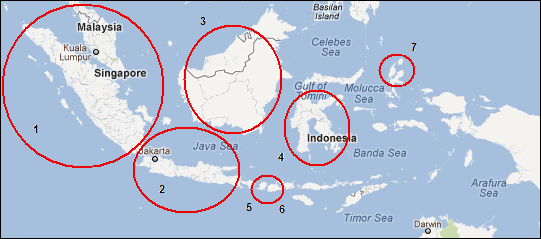
Around 87 percent of the Indonesian population is Muslim, and thus it is the dominant religion in Indonesia. Indonesian islands with a clear Muslim majority population:
1. Sumatra
2. Java
3. Kalimantan (coastal areas)
4. Sulawesi
5. Lombok
6. Sumbawa
7. North Moluccas
Indonesian Islam and Modernization in Indonesia
What is also interesting is that Indonesia has been experiencing decades of robust economic growth (including strengthening purchasing power and growing per capita GDP) and urbanization (a process that is closely linked to modernization and industrialization). And so, the Muslim community is also highly affected by these developments.
In the country's bigger cities (particularly on Java, Indonesia's most populous island) the Muslim community is increasingly displaying consumerist lifestyles. They are increasingly living a modern urban lifestyle, equipped with the latest electronic devices and fashion. In sociological and academic circles, this trend is known as 'pious consumerism' or 'market Islam'. It proves that modernization and rising wealth do not necessarily lead to secularization. Instead, in Indonesia, wealth has allowed people to express their Islamic identity through modern consumer habits.
Wearing the hijab (locally called kerudung or jilbab) shifted from being a strictly religious or political statement in the 1980s to a massive, multi-million-dollar lifestyle and fashion trend by the 2010s and 2020s. Middle-class urban Muslim women highly value high-end, designer Islamic wear, and major Muslim fashion weeks are staple events in Jakarta.
On the other hand, despite Indonesia having the world's largest Muslim population, the market share of Sharia banking has historically struggled to get past the 8 percent mark of total banking assets. It seems to be the case that Indonesian Muslims are highly pragmatic. Conventional banks often offer better mobile apps, lower fees, more ATMs, and better interest/return rates. Urban Muslims happily use conventional banks for their daily lives because mainstream Islamic scholars in Indonesia generally view conventional banking as permissible, meaning there is little social pressure to switch.
Radical Islam in Indonesia
Particularly in the 2000s and 2010s, media --both national and international-- often reported on radical and extreme Islamic attacks on minority religions in Indonesia (such as the Ahmadiyya and Christians) and the Bali and Jakarta bombings in the 2000s. Some radical Muslim groups such as the Front Pembela Islam (FPI or Islamic Defenders Front) and extreme groups such as the Jemaah Islamiyah used violence (or the threat of violence) to achieve their ideals; also against the Muslim community itself, for example by attacking Muslims who sell food during the daytime when the holy fasting month of Ramadan arrived.
In some cases, the Indonesian government or the Indonesian judiciary did not take a firm stance against such radical groups. In other cases, Indonesia's elite counter-terrorism squad Densus 88 (with international backing) did an excellent job at neutralizing terrorist networks. Terrorism and radicalism in Indonesia is being suppressed much better in the present compared to the 2000s and early 2010s.
However, it should be emphasized that the overwhelming majority of the Indonesian Muslim community is highly supportive of the religious pluralist and harmonious society, and is not in favor of using violence against both Muslims and non-Muslims. Unfortunately, this peaceful majority has often remained a "silent majority," while a small radical fringe has remained highly vocal.
Yes, Islam has become more visible on the streets of Indonesia. For example, there are significantly more women who wear the jilbab now compared to the 1990s. However, it is important to underline that Islamization should not be mistaken for Islamic radicalism (or Islamism). Only a small portion of Indonesian society can be labelled 'radical' or 'hardline', while an even smaller portion is willing to use (or agrees with the use of) violence to uphold Islamic norms and values.
Finally, although Muslim radicalism in Indonesia has been given much attention since the 9/11 attacks in New York and the Bali and Jakarta bombings in the 2000s, it is actually not a new phenomenon in Indonesia. Incidents involving Islamic terrorism occurred long before, such as the Darul Islam rebellions in the 1950s, the massacres of communists in 1965-1966, an airplane hijacking in 1981, multiple attacks on Christian churches and Buddhist monuments, as well as multiple actions against brothels, bars and casinos in recent decades. For more information on this topic, you can visit our Radical Islam page.
This section was last updated on 13 June 2026
Latest Reports
- Hormuz Breakthrough Fuels Indonesian Market Rally; Stocks and Rupiah Strengthen
- Against the Tide: Indonesia’s Danantara Defies Outflows with $4.6B Debut Bond Demand
- Bank Indonesia Goes for Unexpected Interest Rate Increase to Support Rupiah
- BI Forex Reserves Hit 2-Year Low as Currency Interventions Intensify
- Curbing Political Pressure: Labour Activist Said Iqbal Tipped to Join Prabowo’s Cabinet