
18 June 2026 (closed)
Jakarta Composite Index (6,172.34) -48.40 -0.78%
War in Middle East Causes Shortage of Plastic – How Is the Economy of Indonesia Affected?
Plastic, a synthetic material typically used for packaging and bottles, is derived from hydrocarbons that are found in fossil fuels, specifically natural gas and crude oil. The raw, virgin materials that serve as the base for all plastic products are called resins (a high-viscosity substance that can be converted into polymers).
There are natural resins (from plants or insects), but what we focus on in this article are the synthetic resins that are used in most packaging across the world.
A plastic factory typically starts with plastic resin pellets (often called nurdles) that are heated until they become a thick, honey-like liquid. Next, chemicals are mixed in to give these resins specific properties, such as UV resistance, colour and flexibility. In the final stage, it is blown into a shape to create the final product.
Advantages and Disadvantages of Plastic
Plastic is a crucial material around the world, including in the economy and society of Indonesia, because of its unique physical and chemical properties. Its ability to be molded into precise shapes and compatibility with sterilization processes makes it an indispensable product for packaging, syringes, prosthetic limbs and bulletproof vests, while plastic is also very light and thus an advantage in terms of logistics.
Moreover, plastic has a real durable quality as it does not rust, rot or corrode. It also does not break as easily as glass. This means that plastic is great for infrastructure (such as pipes) and insulation. Plastic is also very cheap to produce at scale.
While plastic is incredibly useful because it is cheap, lightweight and durable, those same qualities create significant environmental and health challenges. As plastic is designed to last (being a synthetic polymer), bacteria cannot break it down. Instead of biodegrading, it photodegrades, which means that sunlight breaks it into smaller and smaller pieces. Therefore, a standard plastic bottle can take more than 450 years to fully decompose.
In fact, something which has become a hot topic in recent years, when plastic breaks down it turns into microplastics (pieces smaller than 5 mm). These microplastics have now been found everywhere, from the deepest parts of the ocean to the air we breathe and even inside the human bloodstream. Scientists are currently studying the long-term health effects of these particles.
To make plastic flexible or colourful, manufacturers typically add chemicals such as BPA (Bisphenol A) or Phthalates. Some of these chemicals are endocrine disruptors, which means they can interfere with hormones if they leach into food or water.
While development with recycling is underway, the reality of plastic recycling is still challenging as only around nine percent of plastic ever produced has been recycled. Meanwhile, unlike glass or aluminum, the quality of plastic degrades every time it is melted down. Therefore, a plastic water bottle cannot become a water bottle again. Instead, it is turned into a lower-grade item, such as carpet fibers or park benches.
And lastly, given that plastic is a byproduct of oil and gas, its production contributes significantly to carbon emissions. Estimates suggest that by 2050, the global plastic industry could account for 20 percent of the world's total oil consumption.
The Role of Plastic in the Indonesian Economy
Plastic is a cornerstone of Indonesian society and the economy. As discussed above, it brings huge advantages, but also great disadvantages (particularly in the form of pollution). According to Australia-based market research company IMARC Group, the Indonesian plastics market was valued at USD $7.84 billion in 2024. This is seen rising at a compound annual growth rate (CAGR) of six percent to USD $14.03 billion by 2033. Meanwhile, the market size by production volume is estimated to reach 9.3 million tons by 2030, growing at a CAGR of 4.8 percent from 2025.
Usage of plastic in Indonesia is characterized by a mix of industrial necessity as well as deep-rooted consumer habits. A significant portion of the Indonesian population buys products in sachets such as coffee, shampoo, detergent, and seasonings. These products are packed and sold in small (and cheap) plastic laminate pouches. But unfortunately, these multi-layer plastics are technically difficult to recycle (and one can often find the empty sachets thrown away on the streets).
Around 48 percent of all plastic that is used in Indonesia goes into packaging such as snacks, frozen foods and dry goods as well as polyethylene terephthalate (PET) used in the beverage industry for bottles (an industry that is driven by high demand for bottled water and ready-to-drink teas and coffees in Indonesia). Meanwhile, as urbanization in Indonesia accelerates toward a projected 70 percent by 2040, plastic is increasingly used in PVC piping (essential for the country's expanding water and sanitation networks), insulation, and roofing (used in new housing and government infrastructure projects, such as the new capital city in East Kalimantan).
Specific industries such as the automotive industry are also massive consumers of plastics. Indonesia aims to produce two million cars annually by 2030. Considering a modern car contains up to 200 kilograms of plastic (to reduce weight and improve fuel efficiency), the automotive sector is a main driver for high-performance plastic resins.
[...]
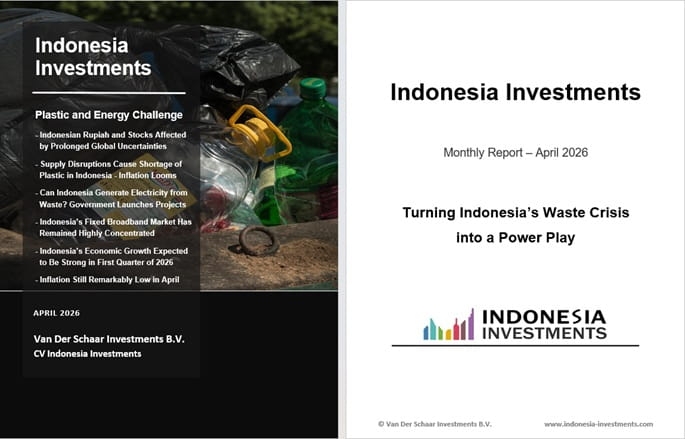
These are the first couple of pages of the report. Want to order the full story? Then order the April 2026 report! This report (an electronic report, PDF, in English) can be ordered by contacting us through email and/or WhatsApp:
- info@indonesia-investments.com
- +62(0)882.9875.1125
Price of this report:
Rp 100,000 (or equivalent in other currencies)
Bahas
Silakan login atau berlangganan untuk mengomentari kolom ini