
4 June 2026 (closed)
Jakarta Composite Index (5,839.79) -101.28 -1.70%
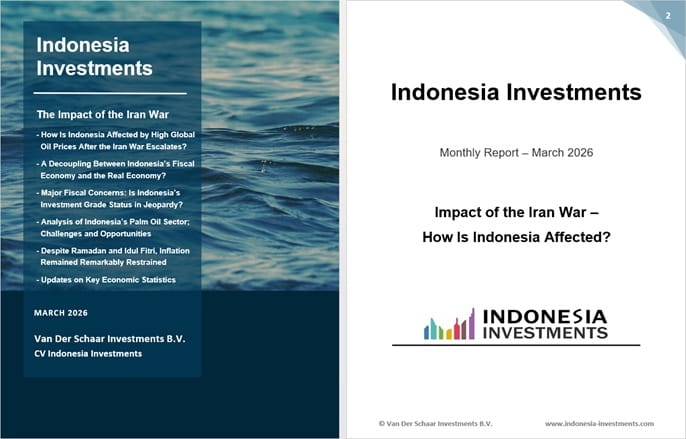
Concern Over Escalating War in Middle East – How Does It Affect the Indonesian Economy?
While Indonesia was enjoying the Idul Fitri celebrations (marking the end of the holy fasting month), global financial markets experienced a massive shock. The panic was fueled by concern over a severe escalation of the Iran War after US President Donald Trump set a 48-hour deadline that would expire on 23 March 2026.
While Indonesia isn’t involved in the Iran War in a direct sense, it certainly feels the indirect consequences of this war in the form of increasing energy prices (as the flow of crude oil and fuels has been affected heavily in the Strait of Hormuz) and (other) supply chain disruptions. This means that there is concern over increasing inflation.
In fact, even global gold prices were down by around 9 percent on 23 March 2026 (while gold usually serves as a safe haven asset in times of global economic/political turmoil), with the main reason being that high inflation suggests central banks might need to raise their benchmark interest rates, hence making bonds interesting assets. Moreover, part of the global investor community might have sold part of their gold positions (as gold prices have remained at much higher levels than one year ago) to cover for their losses in other investment assets.
While the Iran War is hoped to be a temporary matter, the world is currently seeing a couple of violent geopolitical conflicts that have carried on for years (most notably the Russo-Ukrainian War and Israel-Hamas War). The fear is that something similar may happen in – and around – Iran, which jeopardizes global energy resilience, and is particularly risky for oil and fuel importing countries (such as Indonesia).
While chances seem low, some are concerned that the ongoing geopolitical turmoil may trigger a new world war. For example, in case China or Russia would engage in direct military actions against the United States (US), or, if any party were to deploy a nuclear weapon (an act that would undoubtedly trigger massive retaliation), then World War III is suddenly not so far-fetched anymore. Moreover, if there occurs an energy crisis (for example by closing the Strait of Hormuz and/or destroying oil and gas production centers), then subsequent economic instability (a crisis) could lead to desperate acts by countries. However, for now, it seems all involved sides want to prevent this from happening, hence are willing to engage in a degree of diplomacy. Still, warfare remains ongoing, and so the risk of a sudden, uncontrolled escalation remains extremely high.
How Did the Iran War Start?
While a decades-long shadow war had been ongoing between Iran (supported by its allies, such as Hezbollah in Lebanon, the Houthis in Yemen, the Syrian government, and the various Popular Mobilization Forces in Iraq) on the one hand, and the United States (US) and Israel, on the other hand, a full-scale violent conflict broke out at the end of February 2026 when the US and Israel initiated an aggressive, joint military operation.
This operation (called Operation Epic Fury) was ignited by a surprise wave of nearly 900 airstrikes targeting Iran’s command-and-control centers, some nuclear facilities (including Natanz and Fordow), and ballistic missile batteries. Crucial at this first stage was the assassination of Iran’s Supreme Leader Ali Khamenei (as well as other top Iranian officials), thereby decapitating Iranian leadership.
One crucial (and effective) way Iran retaliated was by closing the Strait of Hormuz, a waterway between the Persian Gulf and the Gulf of Oman that serves as a passage for oil and gas, while also launching hundreds of drones and missiles at US bases in the Middle East as well as at regional allies, and thus drawing the entire Middle East into a state of active warfare.
[...]
Want to read the full story? Order the March 2026 report! This report (an electronic report, PDF, in English) can be ordered by contacting us through email and/or WhatsApp:
- info@indonesia-investments.com
- +62(0)882.9875.1125
Price of this report:
Rp 150,000 (or equivalent in other currencies)
Bahas
Silakan login atau berlangganan untuk mengomentari kolom ini