18 June 2026 (closed)
Jakarta Composite Index (6,172.34) -48.40 -0.78%
Generating Electricity from Waste – Tackling Two Major Problems at Once in Indonesia
In Indonesian media we read that a number of regional governments in the country threw their full support behind the central government’s ambition to accelerate the development of waste-to-electricity generation. If successful, this program helps to solve two significant challenges Indonesia is facing: the waste problem, and ensuring energy security for both residential and industrial sectors.
The Waste Problem
Those who have been living in Indonesia might have noticed that the country does not have proper waste management. In the rural areas it is common to burn all trash that households produce. While this does solve their waste problem, this habit is not good for the environment. Moreover, inhaling toxic fumes that stem from burning trash contributes to poor air quality and can cause serious health complications.
Another ‘solution’ that is often used is simply throwing waste in rivers (or in other waterways), a habit that causes pollution and is bad for marine life (which can later impact on human health as there is ongoing research on the issue of microplastics entering human bodies after the consumption of fish).
In (sub)urban environments it remains common to burn trash (or throw trash into rivers) too, although there does exist some formal and informal waste management in these areas. Many middle/upper class neighbourhoods use the services provided by garbage men (in Indonesian: tukang sampah). For a monthly fee, the garbage men will pass by the houses (or shops) a couple of times a week (or once a day). Typically, these men rely on open-air trucks or even hand-carts (gerobak) that cannot handle the weight and volume of waste, leading to trash spilling into roads.
Another solution in the (sub)urban environments is that there are some places that collect trash. So, part of the population can bring their waste to these places.
However, while this prevents many households from burning trash in front of their houses or from throwing it in waterways and in nearby bushes, the problem is not solved. The problem is only ‘centralized’ as these garbage men services are still likely to either burn the accumulated trash somewhere or dump it at illegal or legal landfill sites. But the problem with these landfill sites is that they are reaching (or already exceeded) their maximum capacity, thus creating ‘trash mountains’ that pose safety and environmental risks.
The underlying causes of Indonesia’s waste problem are:
(1) Rapid urbanization; the high and rising population density in Indonesian cities leads to enormous daily waste accumulation, thus requiring sophisticated transport and sorting systems;
(2) Changing consumption patterns; there is a fundamental shift in how people live, shop, and eat. While population growth is a factor, the intensity of waste per person has skyrocketed due to modern convenience-oriented habits, including the ‘delivery economy’ (with the food and e-commerce delivery activities giving rise to layered packaging or over-packaging with plastic wrap, cable ties, and multiple plastic bags), rising consumption of ultra-processed food (such as single-use packets of shampoo, coffee and snacks), and rising ready-to-eat lifestyles in the (sub)urban areas;
(3) Infrastructure that has not kept pace with the volume of waste generated; there is a lack of recycling capacity, while most landfills are simply open dumps instead of sanitary landfills meaning toxic liquid seeps into groundwater;
(4) Poverty; as dozens of millions of Indonesians struggle to make ends meet every month, they’re unwilling to pay for services (including waste management services) that they feel are not absolutely necessary; and
(5) Low environmental and health awareness; environmental and health illiteracy allows the existence of this cultural habit of prioritizing immediate cleanliness over systemic environmental health.
[...]
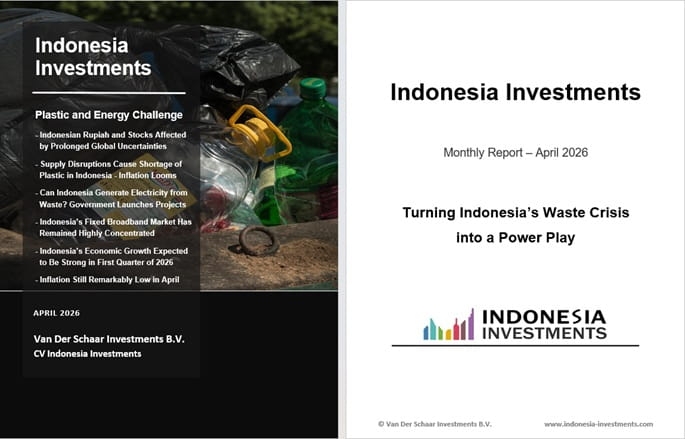
These are the first couple of pages of the report. Want to order the full story? Then order the April 2026 report! This report (an electronic report, PDF, in English) can be ordered by contacting us through email and/or WhatsApp:
- info@indonesia-investments.com
- +62(0)882.9875.1125
Price of this report:
Rp 100,000 (or equivalent in other currencies)