
4 June 2026 (closed)
Jakarta Composite Index (5,839.79) -101.28 -1.70%
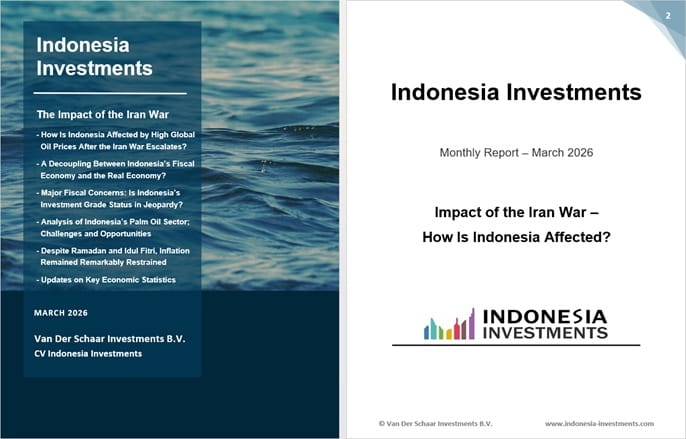
Introduction to March 2026 Report: How the Iran War Impacts Indonesia
The key story in March 2026 is obviously the Iran War that broke out after a United States (US)-Israeli coalition attacked various strategic assets in Iran starting on 28 February 2026, thus causing another (possibly long-term) geopolitical conflict after the Russo-Ukrainian War (2022-present) and Israel-Hamas War (2023-present).
This new war makes one wonder whether controversial US President Donald Trump made a decision that backfired heavily. After the success in Venezuela (where on 3 January 2026 US forces launched a military strike and managed to arrest Venezuelan President Nicolás Maduro in an operation that lasted for 2.5 hours only), Trump may have thought it would be similarly easy to remove yet another crucial oil supplier of China from the market.
But Iran proved to be much tougher than Venezuela. In fact, despite Iran’s military and political powers being demolished to a significant extent, this country still has critical leverage over the US (and the world) as Iran can disrupt global energy prices by restricting the flow of oil and gas through the Strait of Hormuz (which handles 20 percent of the world's oil supply). And, when you have power to intervene in energy prices, then you also have the power to disrupt global financial markets.
This also affects the US. Despite the country producing huge amounts of oil, gasoline prices at pumps around the US are surging rapidly as a consequence of the Iran War. This erodes American purchasing power, thus softening demand for discretionary goods and services in the world’s top economy. Furthermore, considering energy is a vital input for almost all goods and services, businesses will then pass those costs to consumers when energy prices stay expensive.
And amid (the threat of) rising inflation, the US Federal Reserve will not be eager to cut its benchmark interest rates. On the contrary, it might feel the need to raise its key rate. This means that capital will flow into the US, forcing central banks in most other parts of the world (especially in emerging markets such as Indonesia) to keep their interest rates high too (in order to prevent excessive capital outflows), which then undermines loan growth and economic activity in these countries. Based on a calculation by the Dutch central bank, global inflation and energy prices may remain elevated up to mid-2027 in case the Iran War lasts for more than three months.
At the time of writing this introduction, the Iran War (and its possible implications) caused a huge run on cash, particularly the US dollar. Even gold took a big hit as some investors wanted to cash in their profits (after gold prices had soared dramatically in recent years), perhaps to cover losses in other investment assets, and because the expectations of a hawkish response to rising inflation makes the bond market more attractive.
We are likely still in the early stages of an Iran War-induced crisis. What will happen in the next couple of months remains a big question mark as it is easier to start a war than to end one. For sure, Trump’s decision to attack Iran seems to have backfired in a dramatic way: besides the deepening energy crisis around the world (with Asia being particularly vulnerable as this region is highly dependent on shipments going through the Strait of Hormuz), many of the 13 US military bases across the Middle Eastern region have become uninhabitable after being attacked by Iran. Some even argue that this could mean that the US will become (structurally) less prominent in the Middle East in the future, comparing Trump to figures like Caligula or Nero who are often portrayed as people who accelerated the collapse of the Roman empire.
For us, the big question is: how is Indonesia affected by the Iran War? It is interesting to mention here that, last evening, I wanted to fill my car with fuel at the gas station, not far from my house where I’m a regular customer. When I entered the gas station, I was instantly amazed that there were no other cars and almost no motorcycles. A worker then told me that they had run out of Pertamax and Pertalite fuels. When I asked whether it has become difficult for the gas station to obtain new deliveries of gasoline the answer was “no”. Still, the worker couldn’t tell me when that gas station would get a new supply of fuels.
This makes me wonder to what extent Indonesia is already struggling to maintain adequate fuel supplies, particularly now the Idul Fitri celebrations have given rise to massive demand for fuel. So far, there have been no reports of people hoarding fuels or panic buying in Indonesia (hoarding typically only exacerbates a crisis), but I do think twice now before going anywhere by car or by motorcycle (to save on fuel). If many people show this behaviour (avoiding unnecessary traveling or consumption), then this shift in consumer behaviour could lead to a much broader deceleration of economic activity in Indonesia.
And, interestingly enough, in Indonesian media it is already reported that President Prabowo Subianto is considering to impose a temporary work-from-home day (one day a week) so society can save on fuel consumption. A situation that reminds us of the COVID-19 crisis (but shifting to an energy lockdown).
Another major concern is the impact of increasing costs for importing oil and fuel into Indonesia since a significant chunk of fuel consumption is still subsidized (most notably Pertalite) by the government. As the cabinet seems unwilling to raise prices at the gas stations, this could lead to a ballooning budget deficit. This would then be a problem for Indonesia’s investment grade status as the three global credit rating agencies already expressed their concern over Indonesia’s fiscal policies before the Iran War started (Moody’s Investors Service reaffirmed Indonesia’s Baa2 rating but revised the outlook from ‘stable’ to ‘negative’, while Fitch Ratings kept the rating at BBB but shifted its outlook to ‘negative’).
For now, it seems the Indonesian cabinet is allowing the fiscal economy to weaken (by letting the budget deficit balloon) to protect the real economy. But while this is a short-term solution, the threat of decoupling (when the fiscal economy and real economy are moving in opposite directions) is that – eventually – the fiscal economy can no longer support the real economy. This would then cause a bigger disruption to the real economy in the future. Moreover, if government policy leads to Indonesia losing its investment grade status, we are bound to see massive capital outflows that will push the Indonesian rupiah and bond yields to scary levels. Currently, one might want to consider reducing any rupiah-sensitive growth assets and expand inflation-hedged or US dollar-correlated instruments.
Richard van der Schaar, MA Indonesian Studies
Managing Director
Those who want to order the full March 2026 report can contact Indonesia Investments through:
Email: info@indonesia-investments.com
WA: +62(0)882.9875.1125
Price of this report:
Rp 150,000 (or equivalent in other currencies)
Bahas
Silakan login atau berlangganan untuk mengomentari kolom ini